Friday, March 11, 2011

Automatic Stabilizers

We have seen that changes in government purchases, taxes and transfer payments can have an impact on equilibrium aggregate demand. When a government deliberately changes its spending or taxation policies in order to influence aggregate demand, we call that "fiscal policy." But there is another, more automatic way that spending and taxation can influence the economy.

  • Some kinds of taxes rise more than proportionately when income increases. A progressive income tax is an example of this. "progressive" means that the tax rate is higher on higher incomes. Thus, when income in general increases, more people are in the higher tax brackets, and so the average tax rate is higher.
  • Some kinds of transfer payments and government purchases rise when income drops. Unemployment compensation and income supplements for poor people are examples, as are purchases of services for the poor. When income in general drops, there are more poor people eligible for these transfers and services, so spending on them increases.
These taxes, transfers, and purchases are automatic stabilizers of the economy. To see why, think of what happens when the economy goes into a recession, perhaps because of a sudden drop in autonomous consumption. The progressive taxes drop even faster than income, and this decrease in taxes has a multiplier effect, partly offsetting the drop in autonomous consumption, so that equilibrium income doesn't drop as far or as fast as it could. Similarly, the transfers to and services for the poor increase, and these too have multiplier effects and tend to offset the drop in autonomous consumption. Thus, equilibrium aggregate demand drops less than it would have dropped simply because of the decrease in autonomous consumption alone. The economy is more stable.

This works the other way in a boom. An example is the year 1997 in the U. S. A. At the beginning of the year, our government was divided over plans to gradually reduce the government deficit to zero by sometime in the next century. By the end of the year, the deficit was much lower than anyone had anticipated. This happened because, over the year, steady growth of production reduced unemployment to its lowest rate in twenty-five years. This increased growth raised tax revenues and cut transfers, reducing the government deficit. Incidentally, the multiplier theory tells us that the dropping deficit will also have slowed the growth of production, partly offsetting the rise in aggregate demand that would otherwise have occurred.

On the whole, these automatic stabilizers are probably a good thing. If the government has to pass a law to cut taxes in a recession, for example, that can be a time-consuming process. First, the government has to be made aware that there is a recession, and then it makes a law, and then the law takes some time to go into effect. By the time it has an effect, the recession may very well be over and a boom going on -- so that instead of stabilizing the economy, the tax cut makes it less stable. Automatic stabilizers can act in a much quicker and more timely fashion.

We may also hope that the government deficits in recession periods will be offset by government surpluses in boom periods. This is called a "cyclically balanced budget," and probably is the only realistic kind of balanced budget. Unfortunately, it is a potentiality -- a hope -- not a fact.


*Transfer Payment = Payment of money by government to individual for which the payer receive no good @ service directly in return..

The Simple Keynesian Model


The Simple Keynesian Model, which is also known as the Keynesian Cross, emphasizes one basic point. That point is that a decrease in aggregate demand can lead to a stable equilibrium with substantial unemployment.

The Simple Keynesian Model application first explains the roles of consumption and investment and then explains the accounting identity Y = C + I + G. Together, these elements determine the equilibrium level of output.

The policy analysis experiments study the effects of animal spirits and fiscal policy. The numerical results illustrate the calculation of a fiscal policy multiplier.

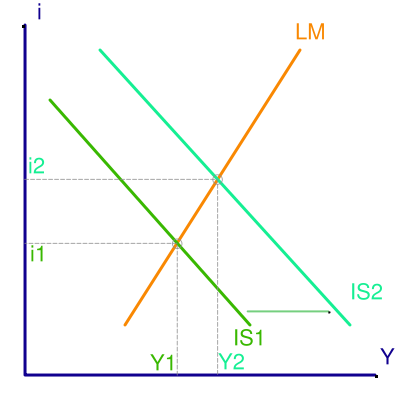
A concluding experiment extends the model to make investment a function of the interest rate. Graphing the shifts in investment caused by changes in interest rates then reveals a simple version of the IS curve found in an IS/LM analysis.

Classical economics

Widely regarded as the first modern school of economic thought. Its major developers include Adam Smith, Jean-Baptiste Say, David Ricardo, Thomas Malthus and John Stuart Mill.

Adam Smith's The Wealth of Nations in 1776 is usually considered to mark the beginning of classical economics. The school was active into the mid 19th century and was followed byneoclassical economics in Britain beginning around 1870, or, in Marx's definition by "vulgar political economy" from the 1830s. The definition of classical economics is debated, particularly the period 1830–70 and the connection to neoclassical economics. The term "classical economics" was coined by Karl Marx to refer to Ricardian economics – the economics of David Ricardo and James Mill and their predecessors – but usage was subsequently extended to include the followers of Ricardo.


There are three basic assumptions of Classical Economics theories. They are:

  • Flexible Prices: The prices of everything, the commodities, labor (wages), land (rent), etc. must be both upwardly and downwardly mobile. Unfortunately, in reality, it has been observed that these prices are not as readily flexible downwards as they are upwards, due a variety of market imperfections, like laws, unions, etc.
  • Say's Law: 'Supply creates its own demand'. The Say's law suggests that the aggregate production in an economy must generate an income enough to purchase all of the economy's output. In other words, if a good is produced, it has to be bought. Unfortunately, this assumption also does not hold good today, as most economies today are demand driven (production is based on demand. Demand is not based on production or supply).
  • Savings - Investment Equality: This assumption requires the household savings to equal the capital investment expenditures. Now it takes no genius to know, that this is rarely the case. Yet, should the savings not equal the investment, the 'flexible' interest rates should be able to restore the equilibrium.

Malaysia should focus on new emerging markets

Malaysia, the world's second largest palm oil exporter, should focus on new emerging markets to offset declining sales in other countries like main buyers China and India.


TH Plantations Bhd chief executive officer Datuk Zainal Azwar Zainal Aminuddin said this would include markets such as Eastern Europe and Pakistan.

"We used to be number one but now overtaken by Indonesia. We have to be more aggressive in cushioning this.

"This effort should be spearheaded by the Malaysian Palm Oil Council," Zainal told Business Times at the sidelines of the Bursa Malaysia Palm and Lauric Oils Conference and Exhibition Price Outlook 2011.

Indonesia overtook Malaysia in 2007 to become the world's number one palm oil producer but traders said the republic continues to grab Malaysia's market share by selling cheaper palm oil to China and India.


As a result, Malaysia's exports to China and India have been declining over the past few years partly due to the undercutting.

India and China also protect their own vegetable oil farmers by increasing import tariffs.

IJM Plantations Bhd chief executive officer and managing director Joseph Tek Choon Yee however said the decline is more of a technical correction rather than Indonesia's move.

"The supply demand situation right now is simply too tight. Although Indonesia and Malaysia account for 85 per cent of the world's palm oil market share, there is still not enough palm oil for the world.

"I believe this is more of a technical correction, China and India demand will come back again in the future," said Tek.


Malaysia GDP Growth Rate


The Gross Domestic Product (GDP) in Malaysia expanded 1.5 percent in the fourth quarter of 2010 over the previous quarter. From 2000 until 2010, Malaysia's average quarterly GDP Growth was 1.20 percent reaching an historical high of 5.70 percent in September of 2009 and a record low of -7.80 percent in March of 2009. Malaysia is a rapidly developing economy in Asia. Malaysia, a middle-income country, has transformed itself since the 1970s from a producer of raw materials into an emerging multi-sector economy. The Government of Malaysia is continuing efforts to boost domestic demand to wean the economy off of its dependence on exports. Nevertheless, exports - particularly of electronics - remain a significant driver of the economy.

Monday, March 7, 2011

Finie Don & Fimie Don


Izinkan akak copy gambo ni ya fimie:) TQ
Dr kiri : Fizie Don, Fimie Don & Finie Don


Salam sume...ngah wat ape tu...Huhu...Malam semalam aku ade la membelek2 FB Si Fimie. Apa y mengejutkan aku ialah kakak Si Fimie tu pon pelakon jugak..Tp kurang popular la....Nama dia Finie..Antara drama y pernah kakak si Fimie ni berlakon ialah kisah kaisara (tu pon pelakon pembantu je)...Maknanya Si Fimie ni lbh popular la berbnding kakak dia...Mungkin cite ni korang da lama tahu tp aku tetap nk bgtau jugak sbb aku br ja tahu...hihihi...Blh tahan la family diorang ni...Happy go lucky..Suka tau I tgk....

Friday, March 4, 2011

Rozita Che Wan Berudung


Cantek seh bila rozita che wan pakai tudung...Sedap mata memandang...Bile la dia nak dpt hidayh kan...Klu la aku cntek cam dia ni, kan best...hahaha:p.....Anyway bersyukurlah dga apa yang ada....

Monday, February 28, 2011

Grooming Wif Dara.Com


Cube teka, y mana satu saye????Huhu...y pakai baju purple tu la.....hehe..Wif Puan Anizon..So sporting tau.....


x ingat dah nape aku gelak sakan tu....


Tangkap gambo ramai2...best sgt2..Cube cari y mana satu I..hihi...I yang kat depan skali tu la..Duduk, 4 dari kanan...


peace:)
Ramai kan:)
Aku dgn muka seyesnya.....
No idea:(
Aku ni suka gelakkan...haish...


Salam sume...ngah wat pe tu??hehe..Actually, pada hari jumaat (18/2/2011), Puan Anizon dan Puan Dinie Awaluddin dari Dara.Com ade datang ke UiTM Seri Iskandar untuk sesi grooming bersempena dengan minggu "Untukmu Wanita" y dianjurkan oleh Bachelor Economic Student (BESTAC). Best sgt2 program tu coz Puan Anizon ada la tunjukkan cara2 nak pakai selendang....Ramai la student y hadir..Almaklumlah, masing2 nak tampil cantek, termasuk la aku..hihihi... Tapi sesi ni aku x brapa minat la....

Ha..y paling menarik minat aku masa sesi ngan Puan Dinie awaluddin...Sesi mekap..Hehe..best2...Tapi x byk sgt pon input y aku dapat coz Puan Dinie just bagi penerangan y asas fasal mekap....Y paling aku ingat kata2 Puan Dinie "MEKAP NI JUST UNTUK KECANTIKAN SEMENTARA". Huhu..pastu dia jugak ada sebut y "X SUME ARTIS TU CANTEK....DIORANG CANTEK PON SEBAB MEKAP"...KLU X MEKAP, HAMPEH, CAM MAYAT HIDUP(SENDIRI PUNYA AYAT, HIHIHI)... Time sesi ni, Puan Anizon ada jugak duduk dekat aku coz ada tempat duduk kosong kat ctu...Aku sempat la tanya fasal eyeliner y x smudge...Pastu dia cakap MAC ok la....Bl aku tanya harga, aduyaiii...RM 160 +++ la...Habis duit PT aku....

K la, penat aku menaip....Enjoy ya dgn gambo2 kat atas ni..hohoho....


p/s Lupa lak nak bgtau..Aku dpt cabutan bertuah tau time ni..hihihi....For the first time dlm hidup( memang jodoh aku ngan dara.com la, muahaha)....Peace, dapat selendang tau;)

Friday, February 25, 2011

Selendang AKA Shawl


Hye u all....Saje je nak luahkan isi hati kat cni...sejak duamenjak ni, kawan2 y kat UiTM Perak ni semakin sakan menggayakan selendang.....teringin jugak cek tp muka cek y bulat ni menghalang niat ni..Tp sekarng rasanya da blh pakai kot coz da ada anak tudung y keras so, x la nmpak bentuk muka sgt....

Selendang sekarng pon da bermcm2 patern, cantek sumenya....Sekali-sekala nak jugak tukar fesyen kan.. Nak nmpak lbh stylo...... hehe:)

Jenis2 selendang y santek2:) Enjoy tau.....Lbh2 lg kpd peminat selendang la..


Apa ke namanya ntah.....Agak menjd plihan...


Y macam ni korang pernah tgk x???Kawan aku panggil shawl ni tudung tasbih coz kat ujung tudung ni ada mcm biji tasbih..hihihi...Jgn marah :)


Y kat atas tu nama pashmina..Aku paling suka y ni la coz besar dan blh menutup aurat. Cuma y x bestnya, akan mudah rosak terutama skali dekat tmpat y kita pin...


X tau la nama pa shawl ni..huhu....Sowy


Shawl ni memang byk la remaja skrang pakai...Cantek kan..I like..


Bob Lokman